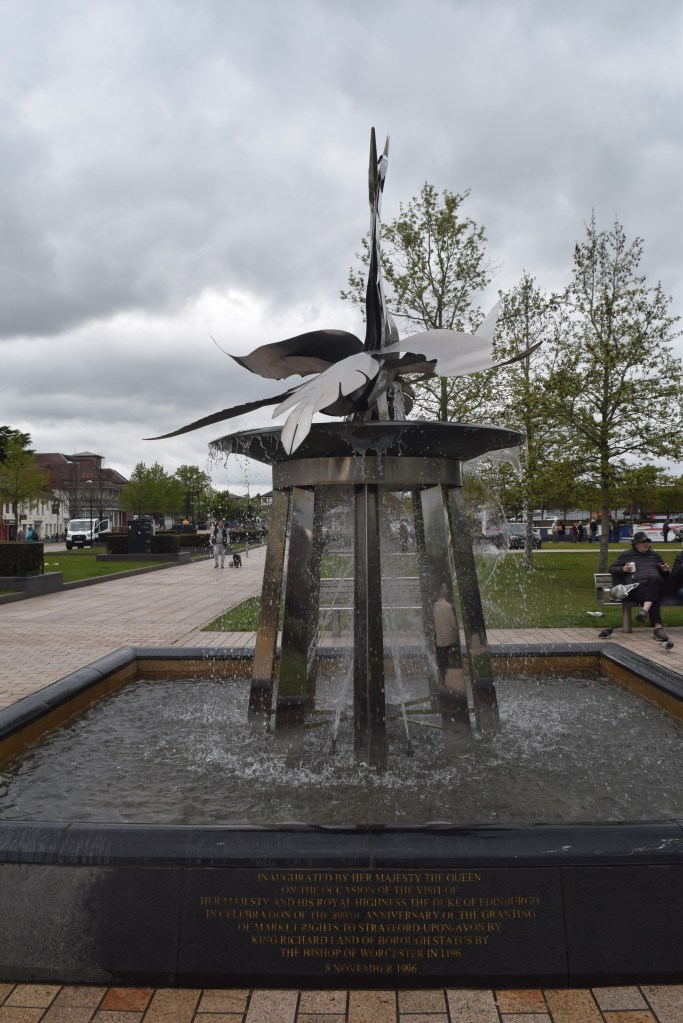
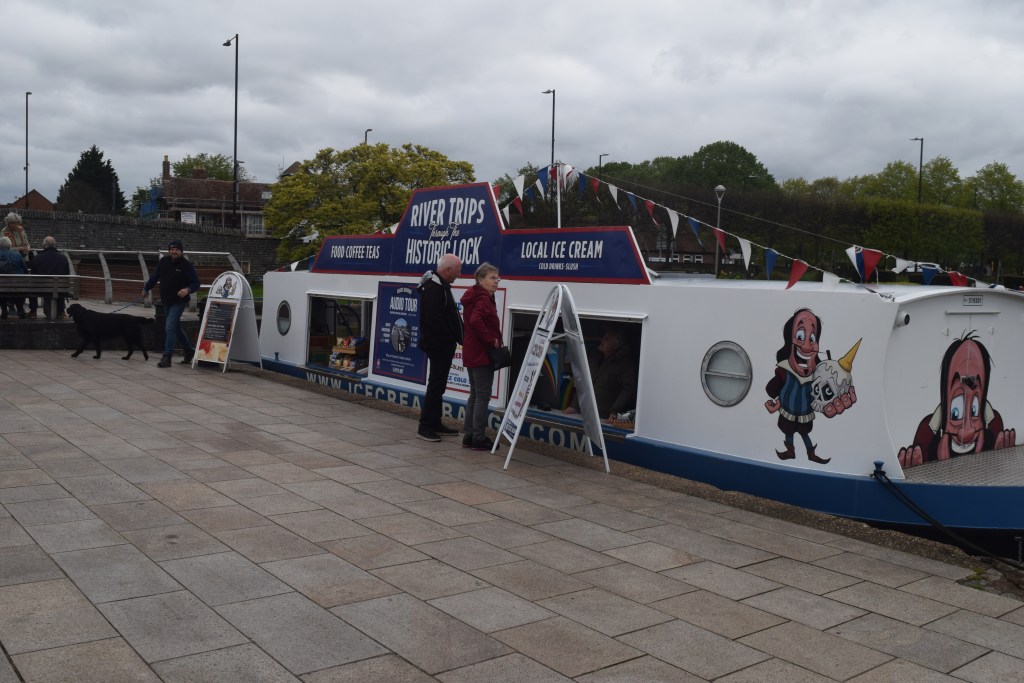
It was 9°C at 10.18am – when we got in the car and made our way to Stratford upon Avon on the 460th anniversary of Shakespeare’s birthday (he was born in April 1564 – no-one’s quite sure of the exact date), a bit of sun was out, a horse was trotting up the pavement, a hotel had a banner outside advertising ‘Weddings – from £2995’, and the multi-storey car park parked in at 10.50am had notices about ANPR everywhere (and our assumption was that meant automatic number plate recognition). 2 tiny little Chihuahuas were being walked along the street we left the car park. Big yellow signs everywhere were advertising the Stratford Marathon (on 21st April), and then we arrived by a fountain (close to the canal) – made for the 800th Celebration of the granting of the Charter for Market Rights by King Richard I in 1196; where it felt cold, and a barge with strange cartoons on was selling ice cream.
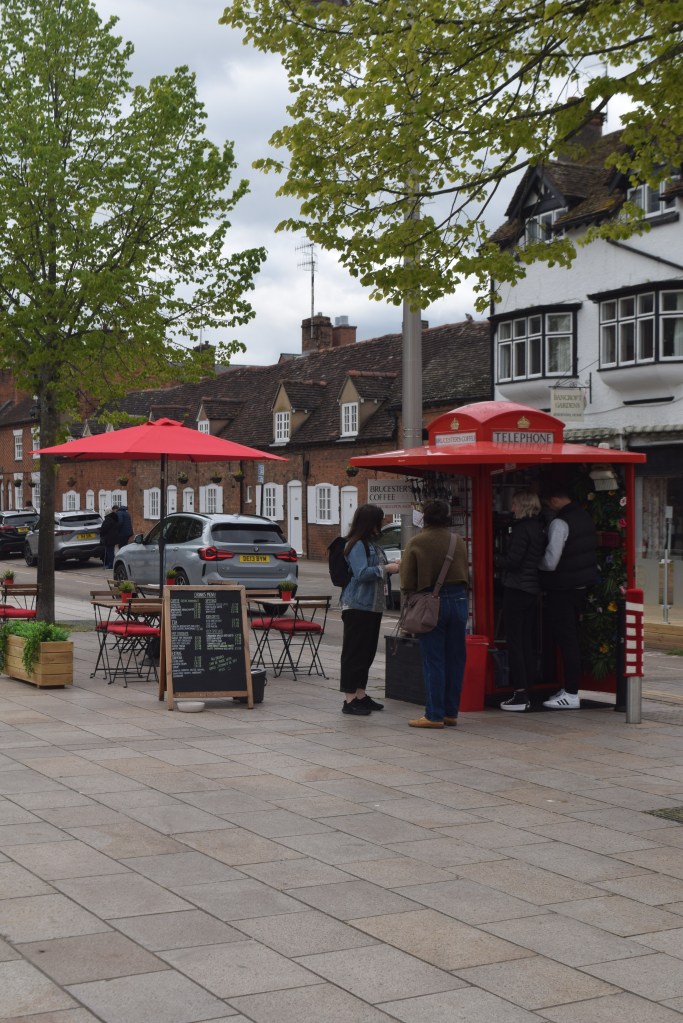
We found the walking tour group there – and a woman in a yellow beret said she’d been a town walk guide for 10 years, that Shakespeare had been baptised on 26th April 1564 – and the belief of people then was that if you weren’t baptised within 3 days of birth you wouldn’t go to heaven. Stratford Upon Avon has it’s name due to the narrow crossing over the river. To do a market in Shakespeare’s era a permit was required – and 1 was gotten on 8th November 1196; and we were all led off: we stopped by a metal bench – stuck up in 2016 – apparently Shakespeare wasn’t very famous in his lifetime, had 3 kids by the time he was 23, lived in London (without family) from the age of 23 to 47, and died aged 52 (on 23rd April 1616); and then the woman mentioned there’s a huge butterfly park and if we were feeling too cold and wanting to abandon ship – (that’s an old British saying: ‘Abandon Ship!’ is a formal command given in the face of danger, usually the imminent sinking of the ship. The order can only be issued by the captain of the ship – the Master – or the person delegated to take command if the captain is unable to – and is usually followed by ‘man the lifeboats’) – we could go there. The big bridge used to be for trams – drawn by horses – and the road led to Birmingham; we were led about 500 metres along the path, told that women could not read in Shakespearean times, that Shakespeare was a good salesman, a property developer, and bought land around Stratford and became very wealthy. The first theatre in the town was built in 1769 (and then 3 loud police motorbikes whizzed over the stone bridge making loud siren noises), there’s now 3 (and I noticed a telephone box selling coffee)…
…and there’s a theatre behind the main one called ‘The Other Place’ (as they’d run out of names by then).
We crossed the road called Waterside; a wall had flood water levels recorded on it, and on Bridge Street – a door with ‘Waterside Fine Art Gallery’ on was next to McDonald’s, there was a restaurant called ‘Greek Cuisine’, and a partially built place called The Chip Shed (and then I noticed a man in the group eating a doughnut). On the corner of Henley Street we were told about the public floggings that went on in Shakespeare’s era (and that the jail is now an Accessorize shop); an Othello taxi passing by was pointed out – and it seems in Stratford – taxis are either black with white writing or white with black writing, as in the playOthello, the main character was a black man who married a white woman.
I noticed a disintegrating place with ‘Dispensing Chymist’ on it, timber framed houses, and wattle and daub houses; and then we reached Shakespeare’s birthplace.
Here it is!
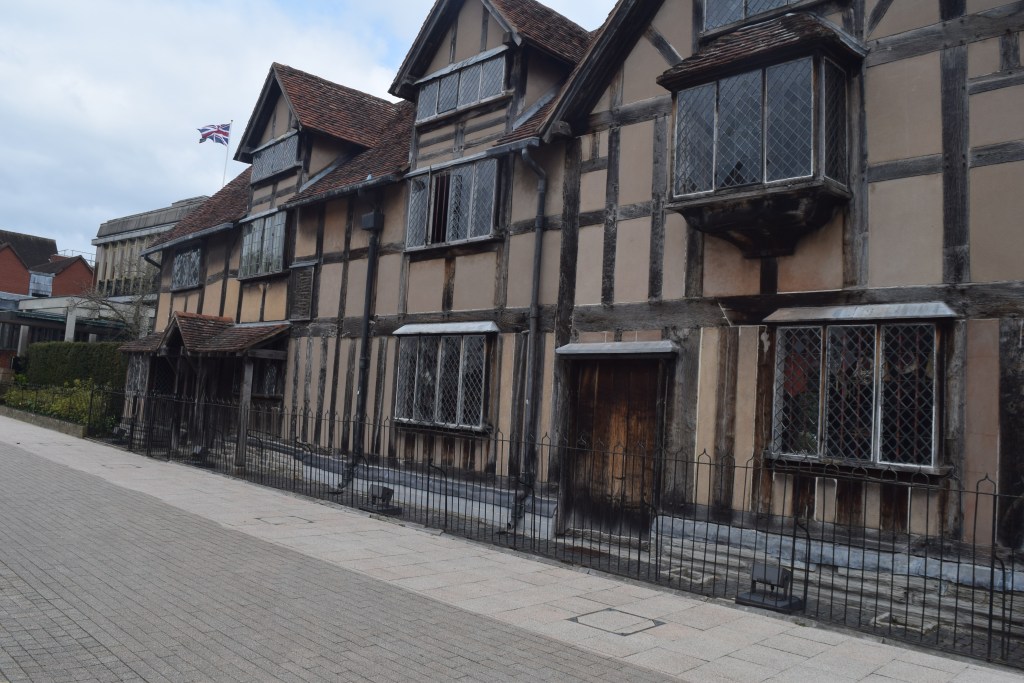
I forgot how many siblings he had, his first child (called Suzanne) was born 6 months after his marriage to Anne Hathaway, and Judith (his second daughter) married the wine merchant Thomas Quiney; and the woman pointed out the lack of ovens in timber framed houses, cooking taking the whole day, and that pies had to be taken to a bakers shop to be baked.
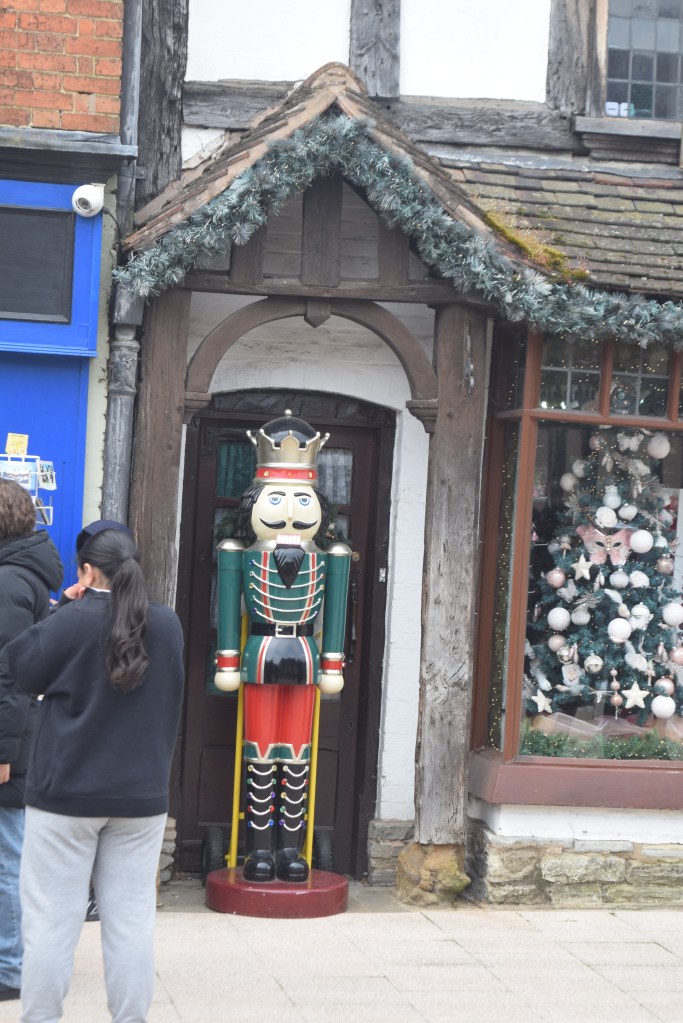
A man was playing a guitar not far away then, and bubbles were coming out of a bubble machine in the doorway of The Works; a slightly disintegrating wooden house was a bit further down – which was Shakespeare’s workshop; an odd plastic statue of a soldier was in a doorway; the tradition of animal skins being tanned was described, cooking in Shakespearean times was described more; and we were told about thresholds, and the way bedrooms worked – with a rocking crib and toddlers in things that pulled out from under the bed.
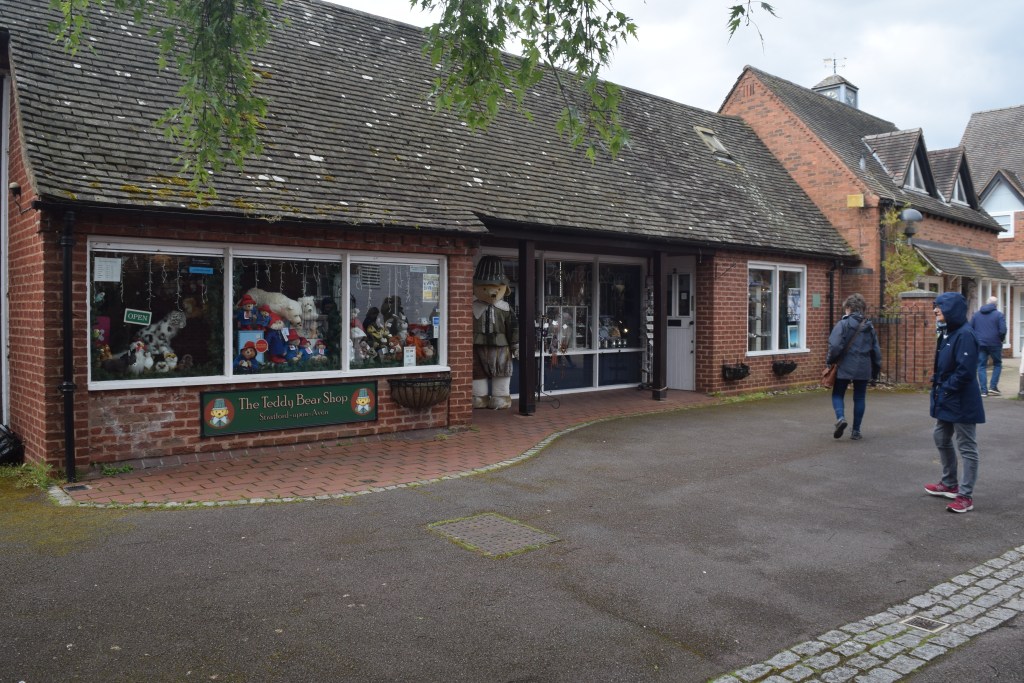
The Teddy Bear Shop, The Plantarium, and Sushi Land were on the next alleyway – leading up Rother Market, where there’s a Victorian stone statue; the next street was Wood Street (and a woman in the group asked if I was a student – so I explained myself); we passed a place selling hair extensions, then Bell Court had a black stone statue of Puck in it (and a Libertine Burger place and Nandos); what used to be Swine Street (as that’s and way pigs were taken to market – rather than straight through the town) is now Ely Street, and it was 12.10pm by then, and I was really really wishing I’d worn my fleece. Carvings in the stone above the HSBC bank on Chapel Street were pointed out, this street had a Sniff and Bark shop on it – and was where Shakespeare’s New Place was built; and then his daughters were briefly mentioned.

Church Street has the Guild Cottages on it (and I spotted a pub sign with ‘Brakspear’ and ‘The Town House’ on). Schooling in Shakespearean times was described: ‘form’ is an old name for a bench – as the whole school was in one room, and students seated on these forms according to their year; learning was by rote, arithmetic was the only maths taught, Latin grammar was taught – and school was 6 days a week (7am -> 6pm), for 50 weeks of the year. Hand beatings and what you got them for were described to us on the corner of Church Street and Scholars Lane; the Greene King pub was opposite The Shakespeare Institute (with a blue plaque commemorating Marie Corelli on it – as she was born and lived there); and next to News On Health, and The Menopause and Wellbeing Centre.
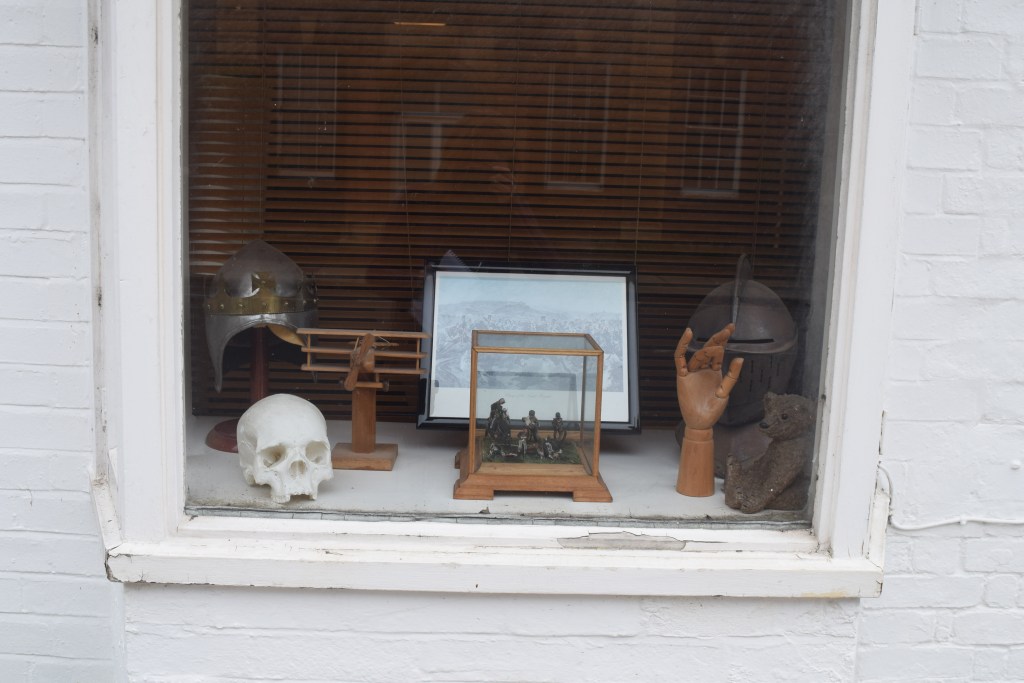
Further down Church Street, Mum pointed out a skull in someone’s front window – in/on Old Town (a street) – by a gate with ‘These premises are alarmed’ notices on…
Doctors being physicians and surgeons being barbers, the lack of hygiene in surgery, and blood letting, leeches, and putting a genuine frog in peoples throats were treatments were all described to us. It was 12.40pm by this point and I was shivering; a very 21st Century lorry with ‘Fews Marquees – Premium Event Structures’ on it was parking further down the street, and a house had purple wisteria all over it.

At the church, our guide told us about Henry VIII and his son – Edward VI – who was 9 when he became King, and the country remained Protestant until he died 5 years later, became Catholic again when Mary was Queen, Elizabeth 1st made it Protestant again, and people who didn’t like it went to America.
It was compulsory to go to church then and you got a fine if you didn’t’; the guide’s description of burials in that time included that at the end of time ‘angels would blow their trumpets’ and the dead would rise from their graves, and that old graves were recycled by digging up old bones; if you were rich enough you bought a tomb inside the church and got an engraving on it, and William Shakespeare who was by that time very wealthy had a curse written on his tombstone (so if you tried to dig him up and prevent him rising up – you would be cursed); and Anne Hathaway (Shakespeare’s wife) was in the church, but no one is sure where. We were told about Elizabeth Scott (1898-> 1972) who designed the main Royal Shakespeare Company theatre known as The Jam Factory by the population of Stratford (due to its ugliness), and the man who designed the red phone box (Sir Giles Gilbert Scott -1880-> 1960); and that was the end of the tour, it was just after 1pm, the guide had a chat to us and asked a bit more about me.
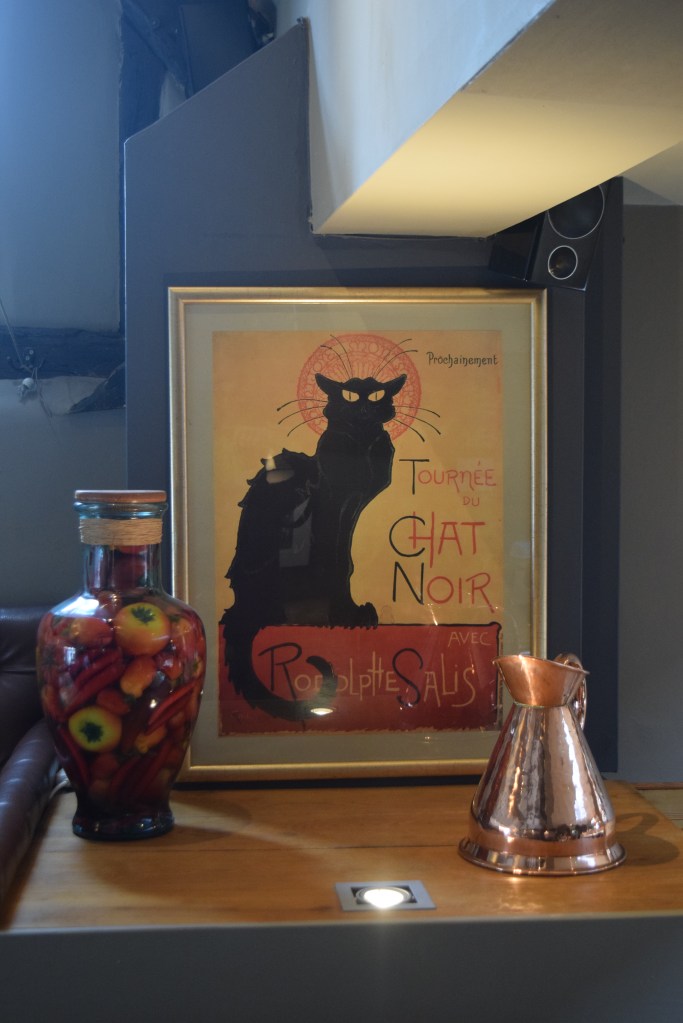
I was shivering, Mum and I went back up Church Street, and as she wanted lunch, we stuck our heads into a couple of places, and seated ourselves in a warm pub sort of place called The Vinter. As we were upstairs in there – I noticed a couple of smashed windows on the top floor of an estate agents across the road; Mum consumed (and managed not to slurp) some soup, I noticed an odd black cat painting on a wall while consuming my mushroom burger…
…and I was told to visit the toilet.

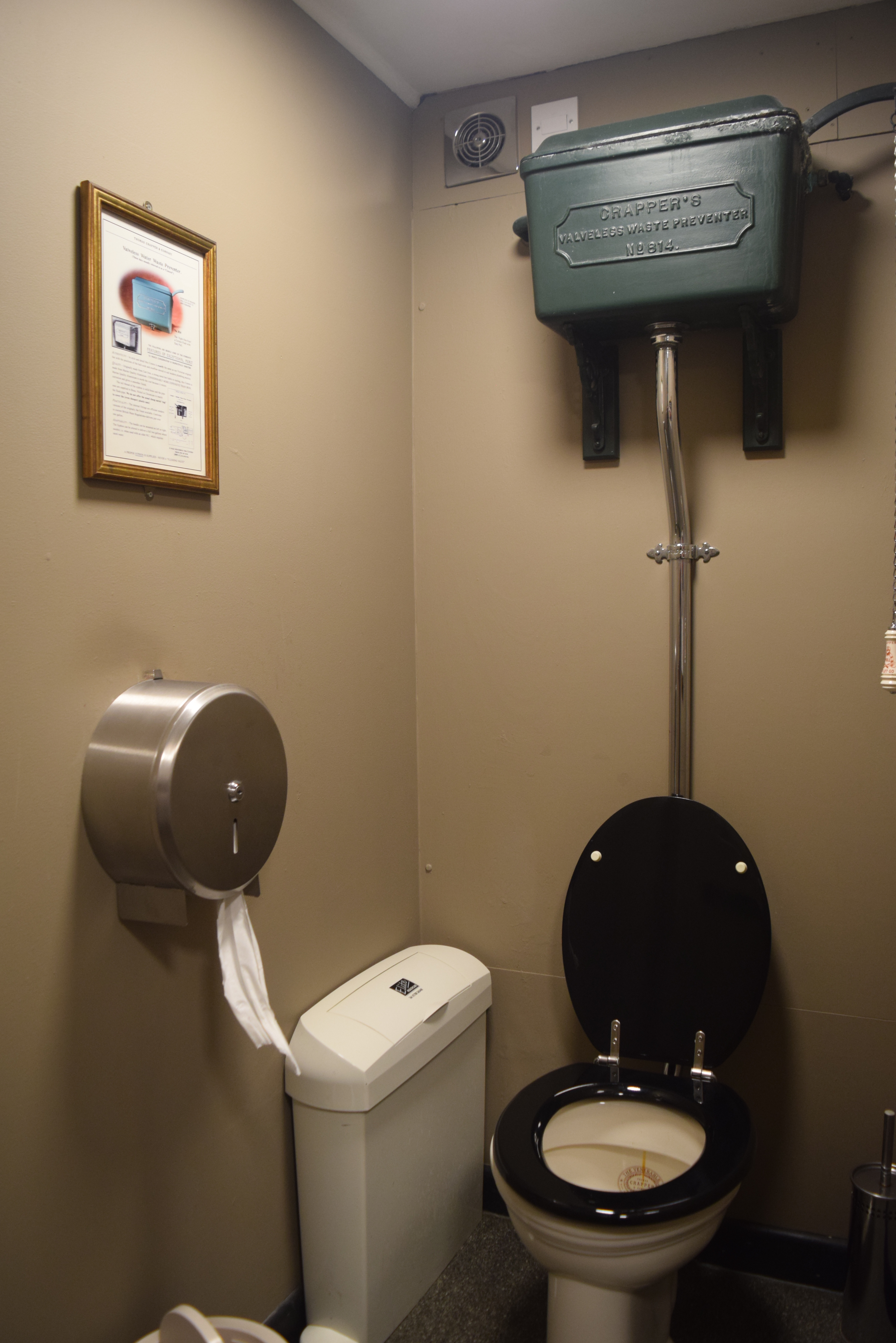
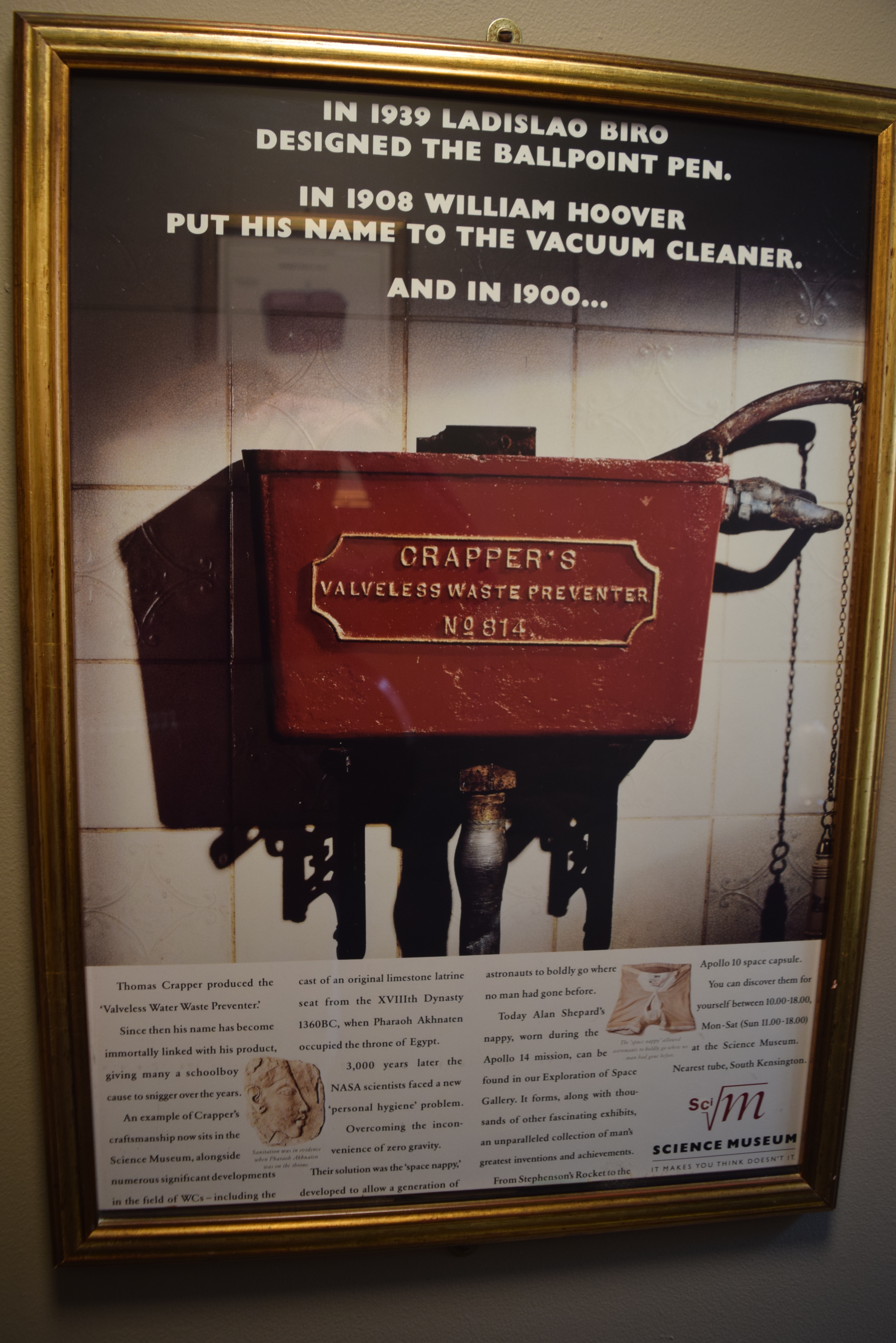
I did, and photographed things; it was just before 2.30pm we got up again. There was a place called ‘The Four-Teas’ , were community support officers in fluorescent jackets, I heard French being spoken, it remained freezing, and it was 2.40pm when we got back to the car.
