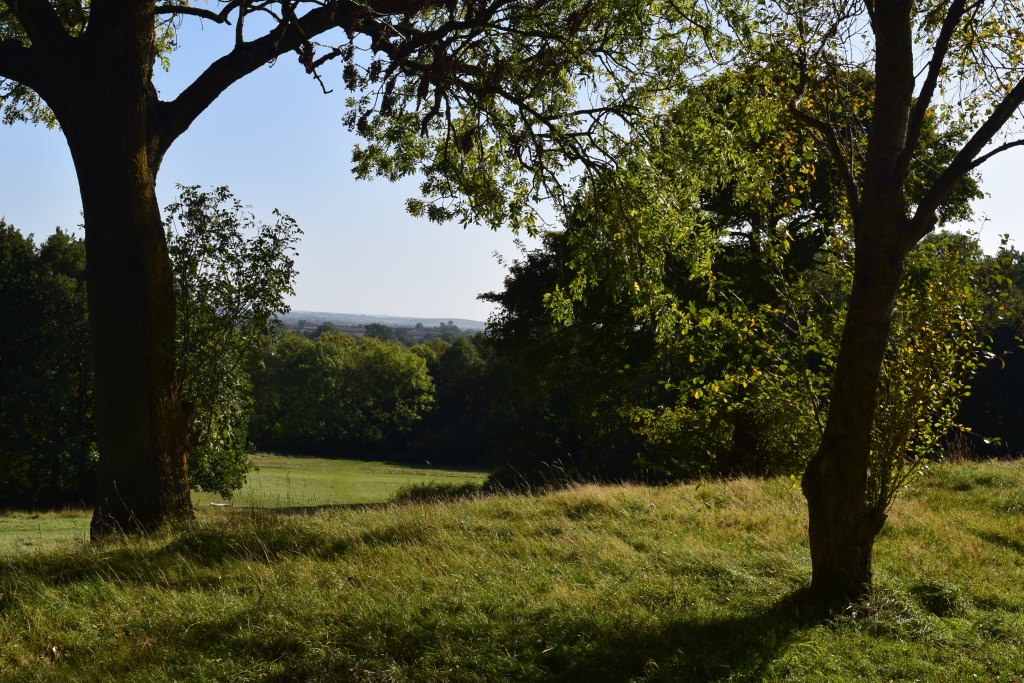
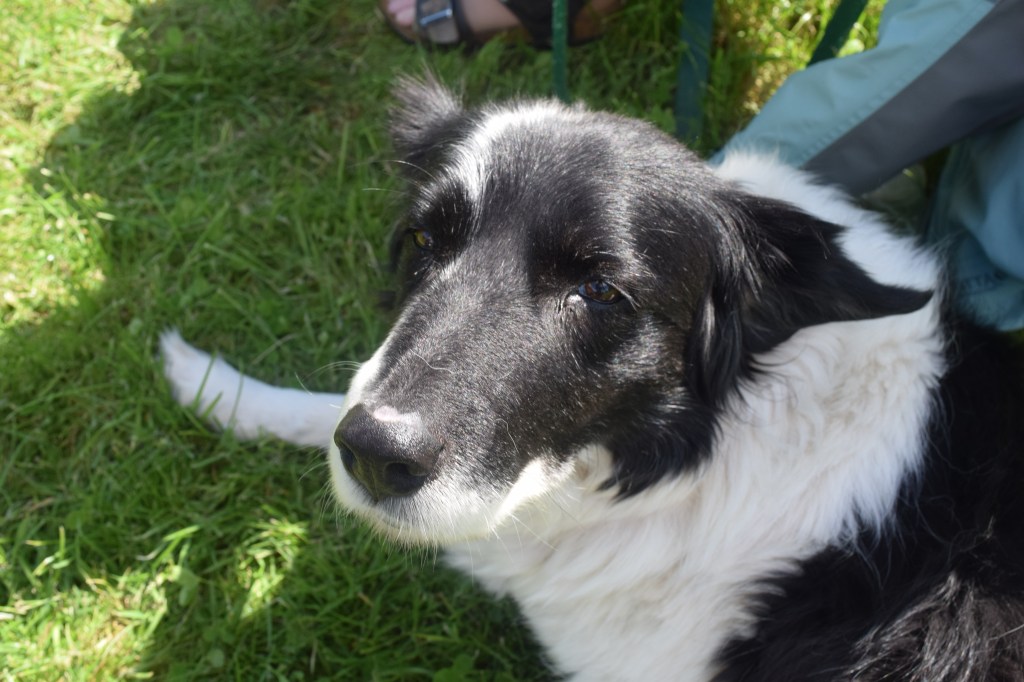
A bumpy track led to this community farm – overlooking some very scenic English countryside – and once out of our car, a very fluffy Border Collie nearby caught my eye, lots and lots of toddlers and slightly older kids were playing on a climbing frame, several polytunnels, and a man and woman playing a guitar; a big barn sort of building – where there were lots of bundles of straw, boxes of mucky old duvets (presumably used for some sort of farming process); a small-ish tractor and trailer, and birds were everywhere – and twittering at a nice volume.
The man doing the walk (showing a group of us round the place) was wearing some very very muddy trousers and wheeling his son (who was sucking his thumb) backwards and forwards in a pram, he said he had previously worked in commercial organic farming and doing organic farming with people with special needs, and talked about the CSA (Community Supported Agriculture) and how the members support the farms. The first stop was a tunnel of new potatoes (a variety called Casablanca), and we were told about their crop rotation system – the purpose of which is to feed people, rather than making money; told about chitting potatoes, and that after the potatoes get harvested, peppers get put straight in; the potatoes were fed a lot, so the peppers now growing won’t need feeding, due to the nutrients the potatoes leave behind (and he said he doesn’t like thistles).
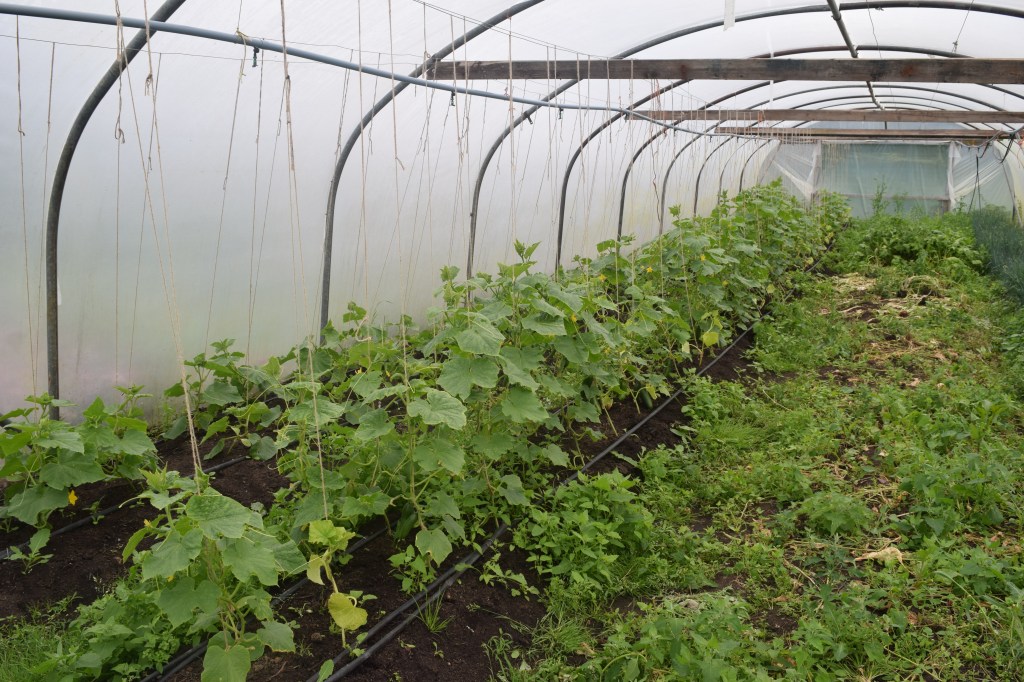
The next tunnel contained cucumbers (the plants were held up by strings dangling from the ceiling of the tunnel), leeks (the latest variety – called Bandit – will crop until the end of May), someone asked about leek moth, another tunnel had 3 beds of tomatoes – also held up by strings from the ceiling, 5 rows of spring onions planted between the 2 rows of tomatoes, and butternut squashes in a separate bed (for irrigation there are sprinklers above the beds and drip lines under them); there’s a ‘no dig’ system here at the moment, so once a year they put a 2->3 inch layer of compost on top of the beds, some farmers give them manure for free, comfrey is also used as a fertiliser on peppers, tomatoes and aubergines (it’s put in a barrel of water – the nutrients dissolve into the water and a filter at the bottom means that you just get liquid – which is the fertiliser – coming out)(he did say that the stuff in the barrel absolutely stinks – I sniffed it and termed it ‘interesting’); a pile of wood pallets with bricks in various places between each 1 was a bugs home, the next tunnel was sugar-snap peas – which take forever to pick, and courgettes (planted in mid April – they’re picking about 200 twice a week), another tunnel had a hotbed of compost (a raised bed that’s filled with manure and covered with compost; and as the manure decomposes it heats up and warms the compost) and we were told that the Border Collie who had been wandering around was called Gaia – and was here because her owner was rock climbing.
Another tunnel had aubergines and carrot plants (and as the aubergines get a lot of aphids on them – marigolds get planted in between the aubergines to keep the aphids out), he described how they make their compost (by turning the organic waste over through 3 bays as it decomposes), and said the only weed problem they get from the compost is more potatoes.
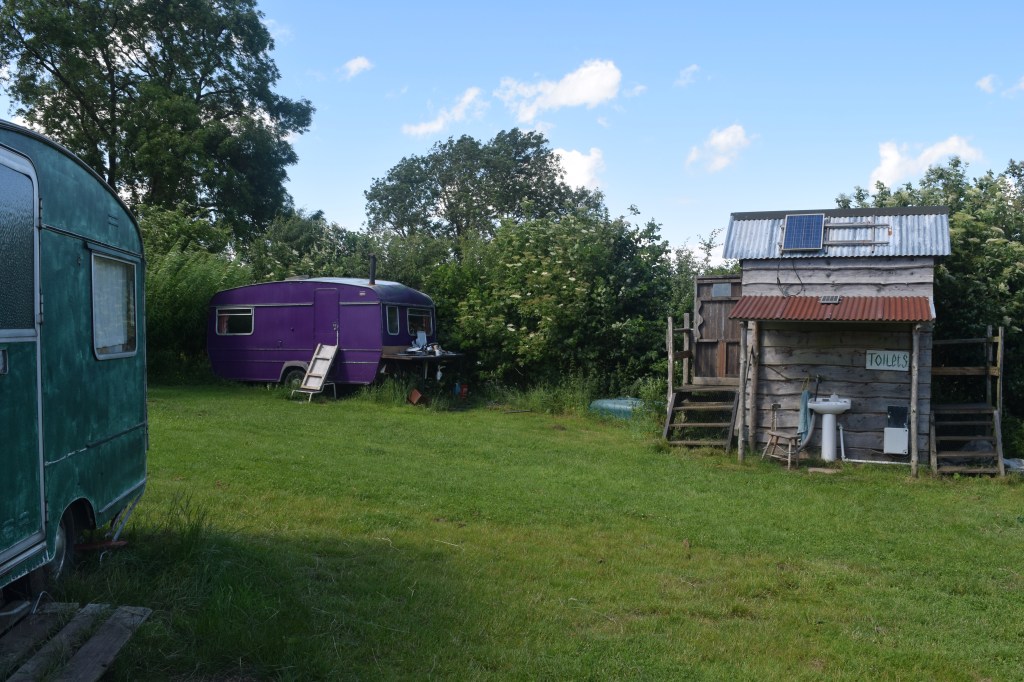
There was a green caravan (used as their staff room), a purple caravan (I’m not sure what that was used for), the big barn was built by the community in 3 stages; big wooden crates used for winter storage (there were really big duvets stuffed in and around those), and a collection area for people to collect vegetables had blackboards showing the weights/sizes of the vegetables in the box below it; and he said they have a squash store/cupboard with squashes in (so they harden up a bit); then when Mum asked ‘how do you build a composting toilet?’ – he said ‘I don’t mean to be coarse, but you basically just shit in a pile’, and elaborated slightly on that by saying that you need worms, air, and carboniferous material.
Afterwards, we were taken down to a field growing asparagus (which he said had a lot of couch grass in it – a weed) – and he was munching a big chunk of cucumber in between telling us this stuff, told us that outdoor courgettes are being grown through a black weed control membrane (a big plastic sheet sort of thing that has holes burnt through it with a blow torch for the plants to grow up through), another row had lots of different brassica plants (cabbages, courgettes and lettuces) in it, and runner beans were in the next row (with canes for them to grow up). About 200m further down this field were lots and lots and lots of potatoes; onions, garlic and parsnips were just sprouting up, and a few carrots (and the field was given a good dose of 10 tonnes of muck per acre); and he mentioned ‘flame weeding’ – which they do to ‘flame off’ the weeds before the parsnips sprout up (the chemistry behind the devices used – called weed burners – got explained).
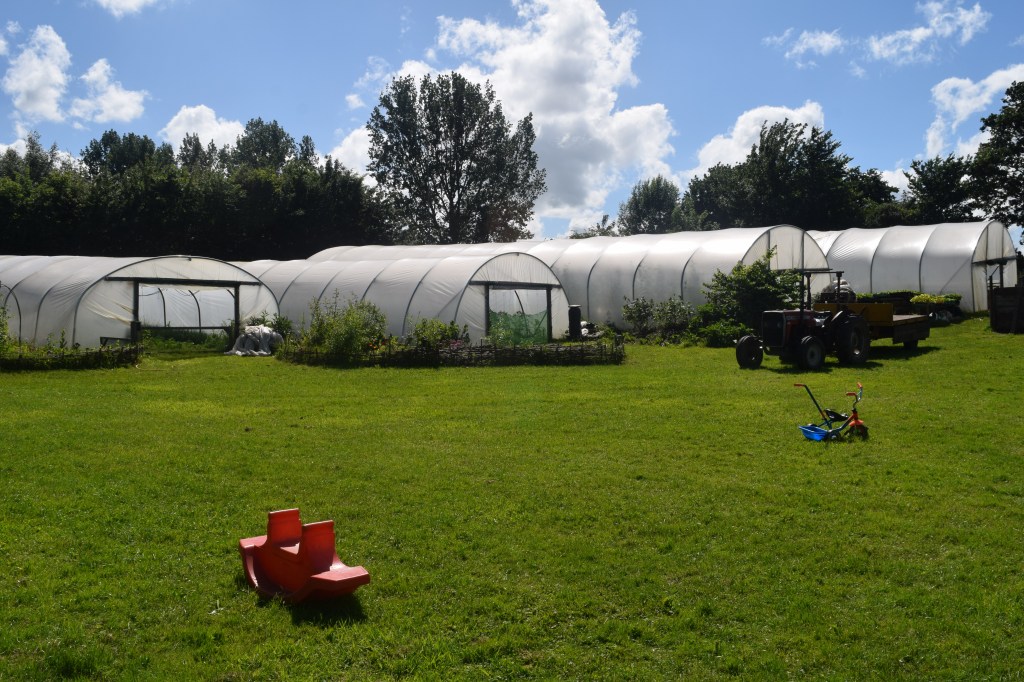
We were taken back to the place we started at (with the climbing frame, polytunnel and dog); Mum went and laid flat on her back on the grass while I asked the man who’d done the tour if I could take some photos, which I then did, and explained the notepad and the encephalitis, and he told me about a project called ‘The Seed Cooperative’. Another bloke nearby who I explained the notepad to asked a bit more about it and mentioned board games (after asking how short term short term is – and if I had trouble with things like games), and wrote down board game recommendations (which were ‘Ticket To Ride’, ‘Carcassonne’, and ‘Catan’) and after that and a little more chatting, we left at 3.40pm (the adjectives in my notepad to describe the place were ‘communal’ and ‘chilled out’).
